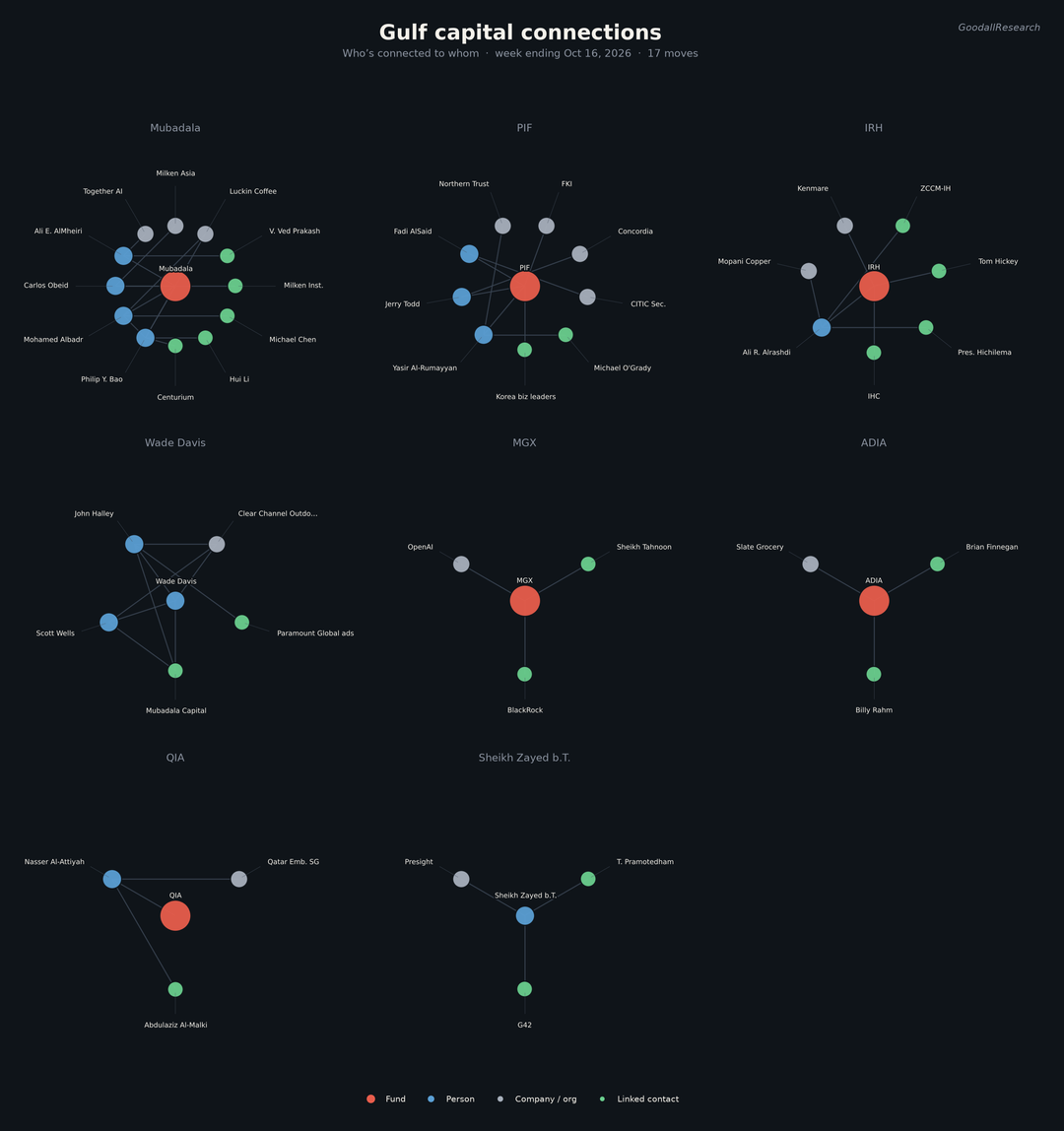
Welcome back. Same question as last week: whose money is it, and who's running it?
This week Abu Dhabi finished taking a US billboard network private, SoftBank went back to the Gulf for AI capital (reported), and the mining vehicle that approached Kenmare reaffirmed a $1.1B copper bet in Zambia. Mubadala showed up three times. Here's what I'm watching.
1. Clear Channel Outdoor closes to Mubadala Capital — Wade Davis in, Scott Wells out
Clear Channel Outdoor announced completion of its acquisition by Mubadala Capital on Oct 14. The transaction is valued at about $6.2B. Common stock ceases trading and leaves the NYSE. I flagged the CFIUS clearance in Issue #1; this is the close.
Why it matters: An Abu Dhabi state-linked buyer now owns a US out-of-home network that was listed on the NYSE. The people on top changed the same day as the money landed.
Who's behind it: Wade Davis is now CEO, succeeding Scott Wells, and sits as Executive Chairman of the Board. Wells stays as an advisor through the transition. John Halley joins as Chief Commercial Officer — he was most recently President of Advertising at Paramount Global (CBS, Paramount+, Pluto TV and the rest). Davis founded ForgeLight, ran Univision/TelevisaUnivision as CEO, and was Viacom's CFO. Mubadala Capital, per the close release, manages/advises/administers over $755B in assets; its core alternatives businesses manage and invest over $60B.
Both new leaders come from TV and ad sales, not billboards. That's a hint at what Mubadala wants from the asset. The parent's CFO, Carlos Obeid, said last week Mubadala aims to deploy about $39B a year (Issue #1). Who decides where that goes is what I'm mapping for paid members.
2. SoftBank seeks up to $100B from Gulf investors for an AI fund (reported)
Reports on Oct 9 that SoftBank founder Masayoshi Son has held talks in recent weeks with senior figures in the region, including the UAE, about raising up to $100B for a fund that would buy companies and use AI to improve their operations. SoftBank did not comment. Reuters said it could not independently verify the report. No Gulf LP is named.
If it lands, it is another giant AI capital ask aimed at the same Gulf pools that backed Vision Fund 1 (Mubadala and PIF in 2017, per the FT) and that are already in the OpenAI conversation I covered last week. Early. Unconfirmed. Worth watching which sovereign names, if any, show up.
Who's behind it: Masayoshi Son. The FT does not name counterparties beyond "senior figures, including in the UAE."
Who to watch: The UAE desks already writing AI checks. MGX, chaired by Sheikh Tahnoon bin Zayed Al Nahyan, is in the OpenAI talks. Mubadala's Ali Eid AlMheiri runs the Together AI partnership. Whether either sits behind Son's "senior figures" is an open question, not a fact.
3. IRH and ZCCM-IH reaffirm Mopani — $1.1B commitment stands; looking past the mine
On Oct 14, International Resources Holding and Zambia's ZCCM-IH reaffirmed their partnership at Mopani Copper Mines. IRH reaffirmed its existing $1.1B investment commitment toward Mopani's operations and development, including a target of 300,000 tonnes of finished copper a year by 2029. IRH holds 51%; ZCCM-IH holds 49%. CNBC Africa / Reuters report that beyond Mopani, the two are also exploring new mineral-exploration and mining opportunities; they describe IRH as a unit of Abu Dhabi's 2PointZero Group.
Why it matters: Same vehicle that made a non-binding approach for Kenmare (Moma titanium, Mozambique) last week. Kenmare's put-up-or-shut-up deadline is still 5pm on Nov 17. This week's statement is Abu Dhabi copper capital saying the Zambia bet is not walking away — and that the hunting ground may be wider than one mine.
Who's behind it: IRH CEO Ali Rashed Alrashdi is quoted on the reaffirmation. The joint statement notes recent engagement with Zambian leadership, including a meeting with President Hakainde Hichilema.
People thread: Alrashdi met Hichilema in Abu Dhabi on Sept 28 (single Zambian source). Eight days later, IRH approached Kenmare. The Irish Times places IRH under IHC, which Sheikh Tahnoon chairs; CNBC Africa/Reuters call it a 2PointZero unit. Tahnoon also chairs MGX. A copper mine, a titanium bid and an AI fund all lead back to one chairman. I'll unpack that structure in the people map.
4. Mubadala highlights NeuroGen with CBC Group — size of any fresh check not stated
On Oct 13, Mubadala's official account highlighted its investment in NeuroGen alongside CBC Group, framing the company as a neuroscience/healthcare platform focused on China. Mubadala's own portfolio page describes NeuroGen as established in 2024 when Mubadala and C-Bridge/CBC carved out UCB's mature China product portfolios. The Oct 13 posts do not state a new check size or stake percentage.
Who's behind it: Mubadala Investment Company with CBC Group. No new named deal principals in the Oct 13 posts.
Who to watch: Mubadala's named China operators are Mohamed Albadr (Head of Asia, Private Equity) and Philip Yifei Bao (Director of Private Equity China), who just joined Luckin Coffee's board after Mubadala invested about $1B. Neither is named on NeuroGen, but Obeid says he wants more in China, and this is the bench.
5. Mubadala may join an INWIT take-private (reported)
Reuters sources said Ardian (32%) and Oak Holdings 1 (39%, backed by GIP/BlackRock, Vodafone and KKR) are arranging financing for a possible take-private of Italian tower company INWIT, and that Mubadala is expected to take a stake as part of the plan. Deliberations ongoing. Ardian, GIP, Vodafone, KKR and Mubadala declined to comment. No formal offer or price announced.
If it happens, Abu Dhabi capital slots into European digital infrastructure alongside BlackRock's GIP, KKR and Vodafone — a different flavor of the same "Gulf money, Western asset" pattern as Clear Channel.
No Mubadala executive is named yet. Watch whose name ends up on it.
6. Risk frame: Reuters counts 135+ Iranian strikes on Gulf infrastructure — Fujairah among the most hit
(Oct 15) An investigation found Iranian drones and missiles struck Gulf infrastructure at least 135 times across at least 84 sites in Saudi Arabia, the UAE, Iraq, Qatar, Kuwait, Oman and Bahrain since the war began Feb 28. The UAE's Fujairah port — the main oil export route outside Hormuz — was struck at least 19 times, with damage to critical loading equipment that Gulf states have often understated in public statements, per Reuters.
Why it matters for capital: This is the pricing backdrop for everything above. Fujairah is the Hormuz bypass. When the bypass gets hit repeatedly, energy risk premia, insurance, and the "safe Gulf" pitch that sovereigns sell to Western LPs all move. Watch how that shows up in deal terms and in what Abu Dhabi and Riyadh choose to take private vs leave listed.
7. Also this week: ADIA money under US grocery stores (members piece)
I published a members dispatch on Oct 15: an ADIA unit backed a $2.34B purchase of 115 grocery-anchored shopping centers (Kroger, Albertsons and related banners), through Everview, a firm founded by Brixmor's lead independent director. Same week Kroger announced 3,000 corporate cuts and Albertsons said it would exit weak markets.
What I'm watching next
- Clear Channel under Davis and Halley — what they actually do with a private US billboard network.
- SoftBank — whether any Gulf LP is named; still early and unconfirmed.
- Kenmare — firm-offer deadline Nov 17 for IRH.
- INWIT — whether a formal offer appears, and whether Mubadala's name sticks.
- Hormuz / Fujairah — risk pricing as the Reuters strike count lands in markets.
Get this every week, free
Gulf Capital Weekly is free. Create a free account at GoodallResearch.com and it lands in your inbox every week.
Paid members get the full picture:
- People maps: who sits where across PIF, Mubadala, ADIA, QIA, IHC and MGX, and who's moving.
- Deal tracker: Gulf sovereign money in Western deals, logged and sourced as it happens.
- Quarterly letter: where the money is going next, based on my data.
— Amanda