Goodall Research
ORGANIZATIONAL ALLOCATION SERIES · JULY 2026 · SHAZ US
Workforce Intelligence · Pre-Earnings Execution Read
Sharon AI slowed up hiring this summer.
It closed a US$1.6 billion financing during the same period.
For the six months prior, the company grew its workforce by 175%. It recruited infrastructure leadership out of Microsoft, AWS and NexGen Cloud. It appointed a chairman who ran Telstra and a chief financial officer who spent two decades at Macquarie. By every observable measure, this was an organization being assembled at speed. Then the capital landed, and the curve went flat.
Organizations disclose what they believe through what they staff. This one has told the market it will have more than 62,000 NVIDIA GPUs deployed by the middle of next year, and that revenue against a US$1.32 billion agreement begins in the first quarter of 2027. That is the gap that does not appear in a price target.
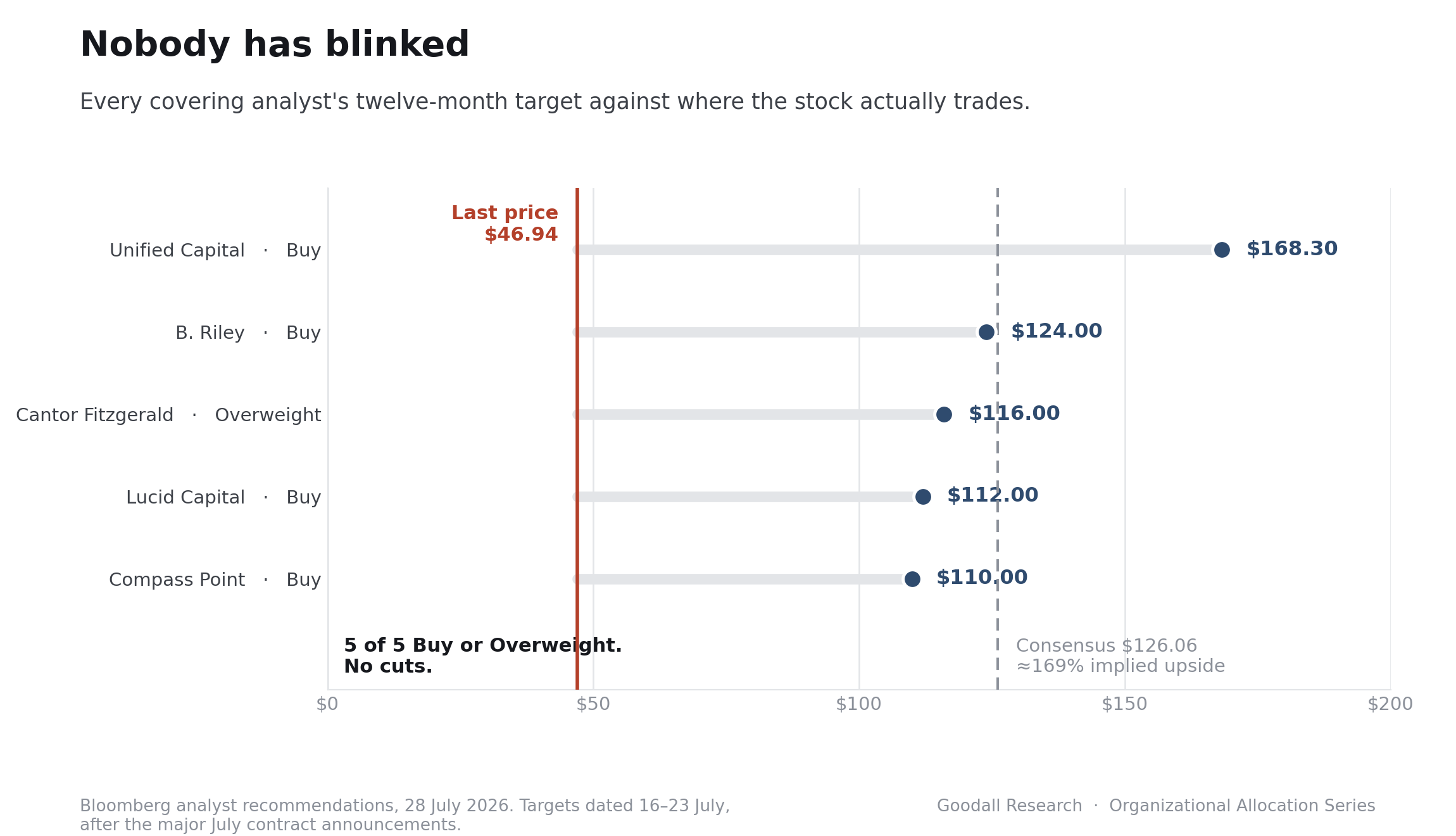
The five analysts that this frameworks watches that cover SharonAI Holdings (NASDAQ: SHAZ). All five rate it Buy or Overweight. The average twelve-month target is $126.06 against a last price of $46.94… implied upside of roughly 169%.
None has cut. None has moved to Hold. The targets were published between 16 and 23 July, after the major contract announcements, so they are current. Meanwhile the stock fell about 20% on 28 July alone, and the options market is pricing implied volatility above 110% into the 6 August earnings call.
Two groups of professionals are looking at the same disclosures and reaching opposite conclusions. The conventional response is to build a third valuation model and adjudicate. That produces no edge: every covering analyst already has a model, and the models are not the disagreement. The assumptions underneath them are.
The framework here rests on one proposition: organizational commitments precede financial results by two to four quarters. Where narrative and behavior align, the announcement has operational substance behind it. Where they diverge, the divergence is the signal.
Three behavioral measures apply here:
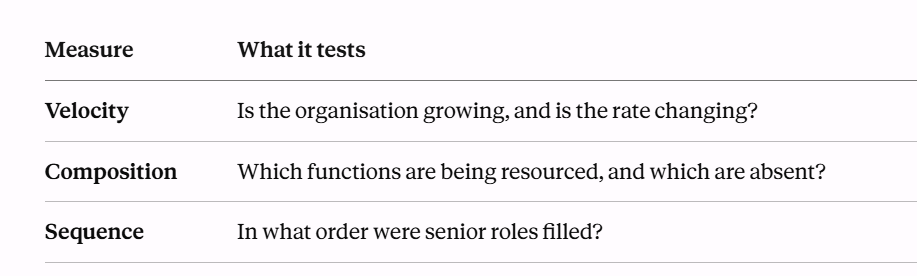
The framework establishes direction, not outcome. It cannot forecast a quarter. What it can do is determine whether management behavior is consistent with the strategy being sold to investors a different question, and an earlier one.
Signal one: velocity
Indexed to July 2025 = 100:
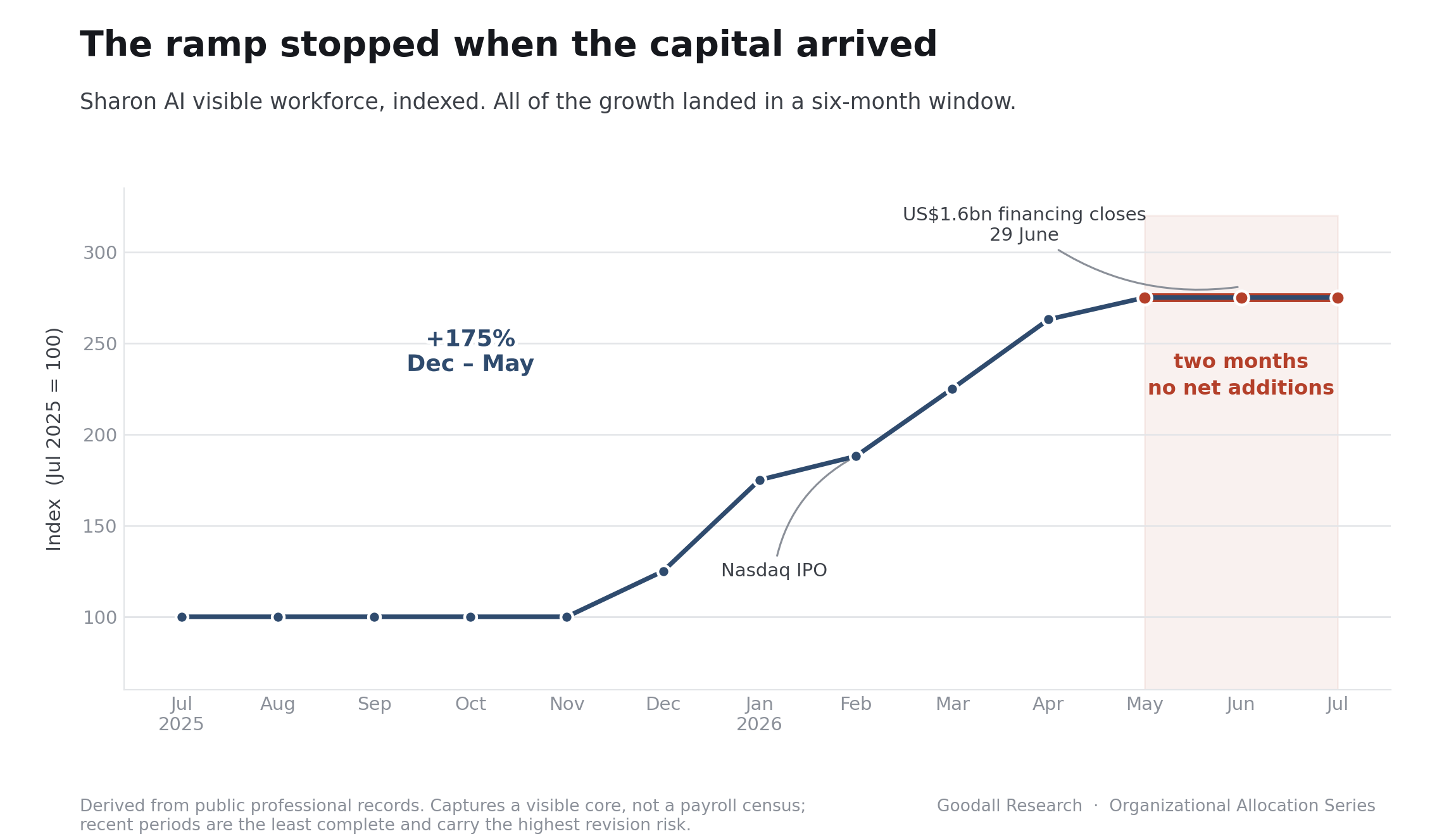
The organization grew roughly 175%, and effectively all of it occurred in a six-month window between December 2025 and May 2026, bracketing the February Nasdaq listing.
The series then flattens. Two consecutive months of zero net additions, beginning the month the company closed an oversubscribed US$1.6 billion private placement anchored by Situational Awareness and Oaktree-managed funds.
Four readings are consistent with the data:
- Recruitment lag. Senior infrastructure appointments run 60 to 120 days from offer to start. A June–July trough is the expected shape ahead of a Q3 intake, and the fourteen open requisitions represent that pipeline.
- Reporting latency. The dataset draws on public professional records, which are updated after the fact. Recent periods are structurally incomplete and revise upward.
- Deliberate restraint. Headcount may be held flat pending confirmation of deployment schedules…. a disciplined sequencing decision rather than a constraint. But the models are watching this closely.
- Binding scarcity. The roles cannot be filled at acceptable cost in a market where every Asia-Pacific neocloud is bidding for the same infrastructure engineers.
Readings one and two are mechanical and, on balance, most probable. Reading four is the one that carries consequence, and it resolves on a fixed timetable.
Signal two: composition
Every role Sharon AI currently advertises, by function:
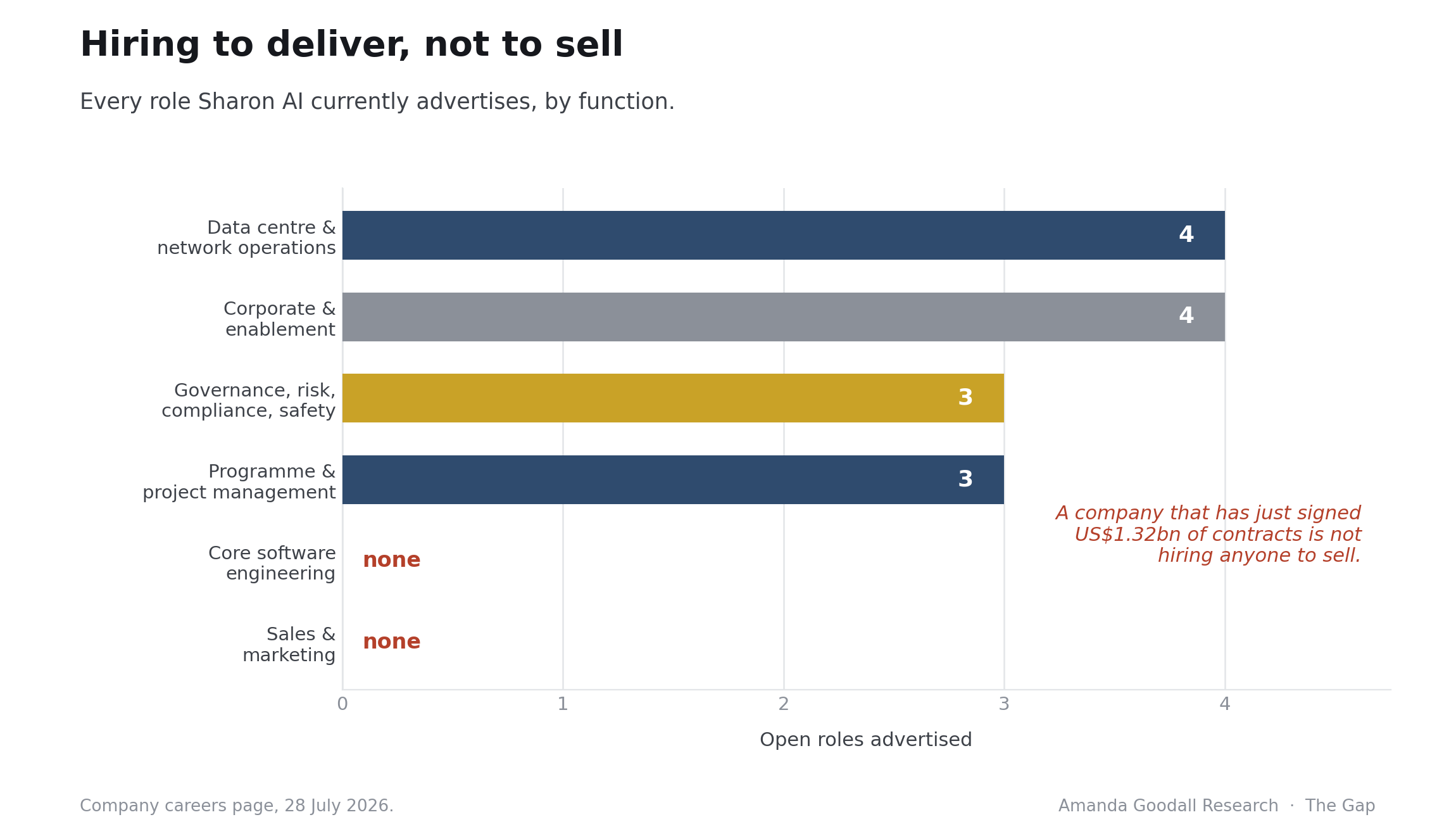
Two absences carry more information than any of the four categories present.
No sales roles. A company that has just executed US$1.32 billion of contracts is recruiting nobody to sell. Either the pipeline is being closed founder-to-founder at executive level… plausible when the addressable customer set is a handful of AI labs and sovereign buyers… or demand is arriving faster than the organization can absorb it. Both are unusual. Neither is bearish.
Governance is over-weighted. 3 out of 14 roles are compliance and safety, and one is a head-of function. Compliance departments do not win customers. They pass audits, clear enterprise procurement, and qualify a vendor for government and sovereign workloads. This is the leading edge of a regulated-customer strategy, and it typically appears two quarters before the associated revenue.
Add the Head of PMO and two technical project managers and the shape resolves: this is an organization industrializing delivery… converting deployment from a heroic activity into a repeatable one. The composition matches a delivery-and-deployment business, not a facilities business and not a sales business.
Signal three: sequence
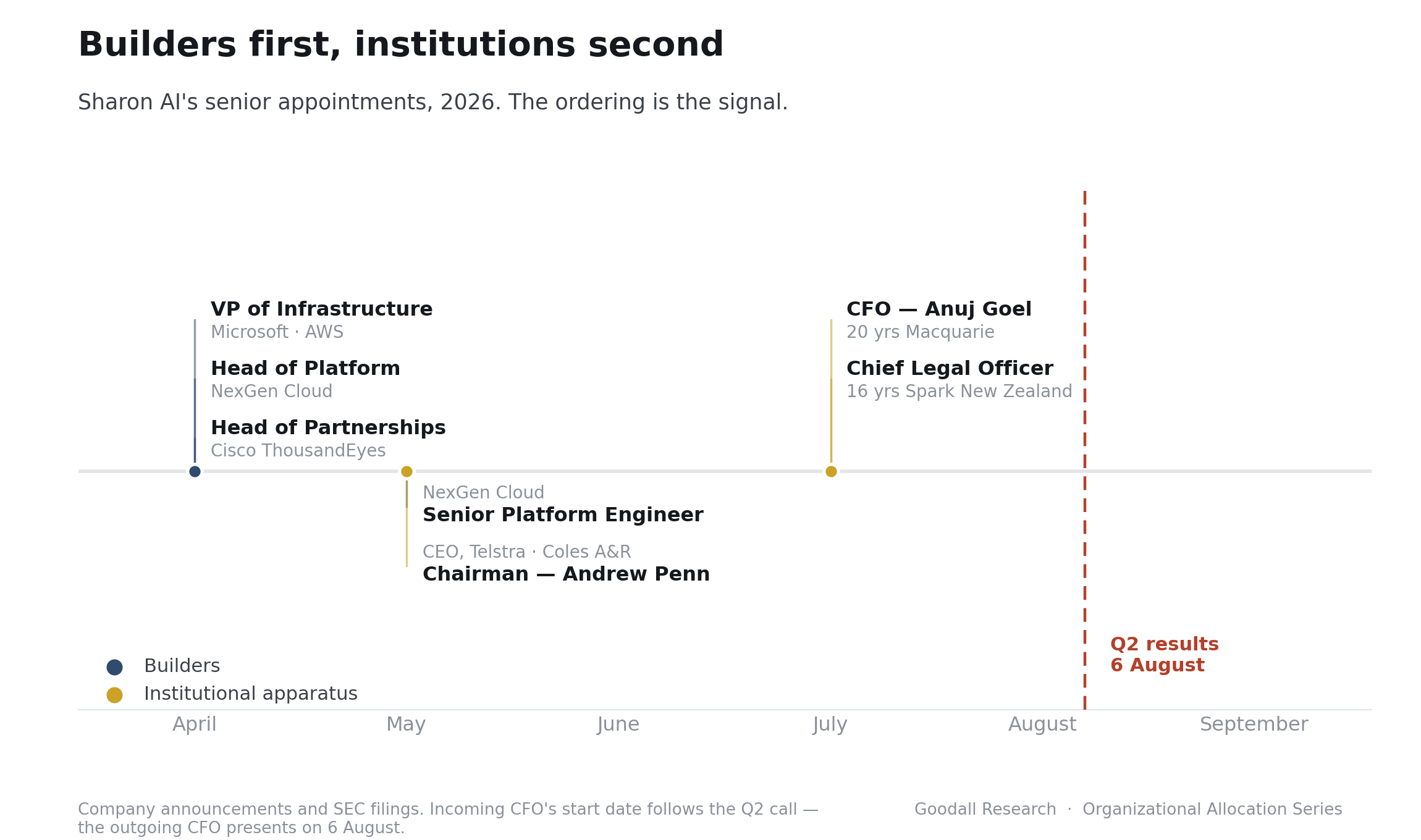
Builders first, institutional apparatus second. Infrastructure and platform leadership in April; chairman, chief financial officer and general counsel from May onward.
That ordering is the signal and it tends to be a very strong indicator within certain industries. The inverse pattern of governance and capital-markets hires ahead of technical leadership characterizes organizations optimizing for a financing event rather than a buildout. Sharon AI ran it the other way round.
One date warrants attention. The incoming chief financial officer does not take the role until 24 August. The Q2 results on 6 August will be presented by the outgoing officeholder, who remains through the handover. The Form 8-K states the resignation was unrelated to any disagreement over the company’s operations, policies or practices, and the joint transition period is consistent with that.
The operational consequence stands regardless: the executive who will own the capital plan through the 2027 revenue ramp is not the executive who will field questions about it on the call. Conservative guidance on 6 August would have a straightforward explanation, a departing officeholder has no incentive to set numbers a successor must deliver.
One correction to how this company is commonly framed, because the headline number invites a category error.
132 MW is not large by global standards. CoreWeave has surpassed 3.5 gigawatts of contracted power. Nebius reports a comparable contracted footprint against a target of 800 MW to 1 GW connected by end-2026. A single phase of Galaxy’s Helios campus runs to roughly 400 MW. Against that field, 132 MW is under four percent of the leading neocloud’s contracted book.
CoreWeave, Nebius and IREN hiring this summer has been the highest or nearly the highest levels seen over the past 12 months.
Within Australia and New Zealand, however, it is materially significant… a smaller market with a dominant incumbent operator, where this represents a genuine national-scale AI position.
CoreWeave’s gigawatt figures describe contracted power supply, grid capacity secured. Sharon AI describes capacity contracted to end customers… demand-side bookings. These are different denominators and are not comparable.
The metric the sector has converged on is activation rate: active power as a percentage of total capacity. CoreWeave sits near 29%. Nebius is around 5–6%. IREN is roughly 4%. Across the category, the overwhelming majority of contracted capacity is not yet operational, and converting it is where the capital and the execution risk both sit.
Sharon AI has not disclosed an activation figure in comparable terms. An 88% contracted rate is a demand signal and a good one. It is not an activation rate, and it should not be read as one.
That is the single most valuable disclosure available on 6 August. How many of the 132 MW are energized and ready to run GPUs now?
Overall, this is where the consensus bear case is stale because most skeptical commentary on this name treats financing risk and dilution as the central unresolved question. Can the buildout be funded? Will shareholders be diluted by an emergency raise into a falling market?
That question was substantially resolved on 29 June, before the current drawdown.
The company closed an oversubscribed US$1.6 billion private placement: approximately US$900 million in equity and pre-funded warrants, plus US$700 million of 4.75% convertible senior notes due 2032, anchored by Situational Awareness and funds managed by Oaktree, with proceeds directed to the NVIDIA compute collaboration.
The terms remain arguable. So does the position that dilution has already occurred rather than been avoided, and that convertible notes are a deferred equity claim. Both are legitimate.
What is no longer arguable is that the buildout is unfunded and contingent on raising capital into weakness. The capital arrived at scale, ahead of the drawdown, from institutions that underwrite infrastructure professionally. A short thesis built on liquidity risk is a thesis against the 29 June filing.
The scorecard for 6 August
The highest-information disclosure available would be the identity of the global AI lab. An unnamed counterparty on a US$1.32 billion five-year agreement is the largest unverifiable input in every model covering this stock. Naming it compresses the discount immediately.
The gap that Goodall Research is seeing right now:
The market is pricing Sharon AI as a company that may not execute. The covering analysts are pricing it as a company that will. The behavioral evidence does not adjudicate between them… but it does indicate the argument is being conducted on the wrong terms.
The question that stands out the strongest here, is whether a tenant with a US$1.32 billion contract book, a funded balance sheet, and an organization deliberately reconstructed around delivery can convert commitments into recognized revenue on a published timetable anywhere from 6 weeks to 12 months.
Every appointment made in the last six months is consistent with management believing it can. That is not proof. It is evidence, and it arrived months ahead of anything that will appear in an income statement.
Markets price narrative. This report has merely measured behavior.
On 6 August, the two are reconciled against each other for the first time.