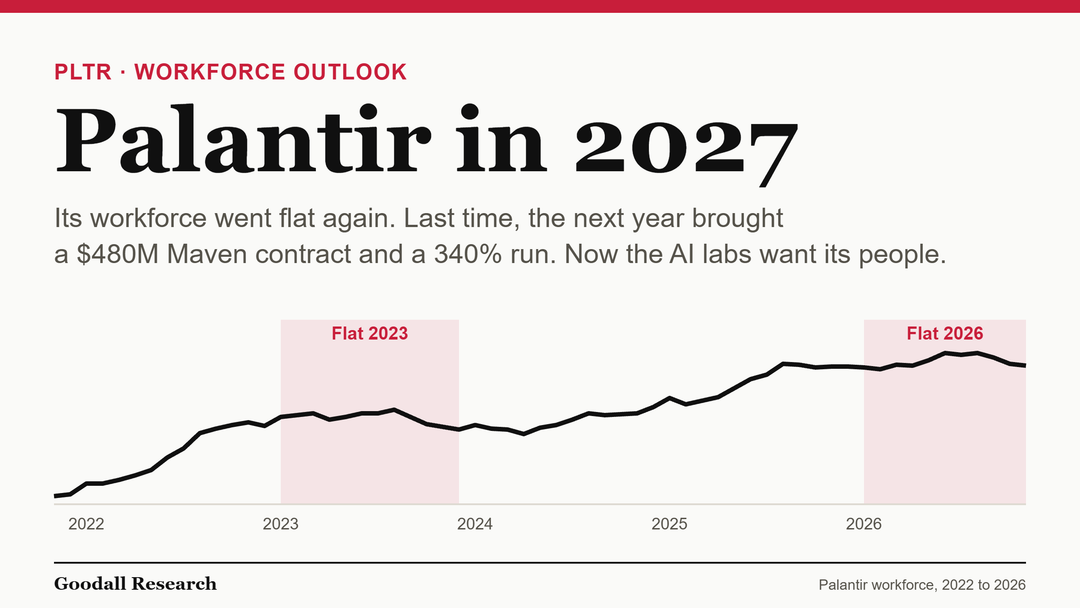
Palantir's workforce is about the same size it was in January. It grew through the spring, peaked over the summer and has come back down since. In the last three months, more people left Palantir than joined it. 2026 is its first flat year since 2023.
The last time this happened, the next year was a big one. In 2024 Palantir started hiring again, the Army awarded it a $480 million contract for the Maven Smart System, it joined the S&P 500, and the stock rose 340%.
2027 has two things 2024 did not. First, the AI labs are building what Palantir is known for. OpenAI launched the OpenAI Deployment Company in May, with $4 billion behind it and about 150 forward deployed engineers, the model Palantir made famous. Anthropic named Teresa Carlson, formerly of AWS and Microsoft, its first global head of public sector in July. Google now hires forward deployed engineers under that title. Over the last 90 days, some of the people filling those teams came from Palantir's government side.
Second, Bloomberg Intelligence expects a new Congress to slow defense technology spending after the midterms, with closer scrutiny of AI systems from Palantir and Anduril.
Palantir is preparing to hire again. It has added recruiters since August, and Alex Karp said on the third-quarter call that the company lacks "even the bandwidth" for the customers it wants to focus on.
Below: who left Palantir and where they went, who it is hiring and what its 166 open roles show, what the midterms change, my calls for the next three months, what I expect for Palantir in 2027, and the workforce signals that will show which way it is going.
The public record of Palantir's hiring, departures and headcount is on my running Palantir workforce page.