Over the weekend, Chamath Palihapitiya posted that neoclouds were disorganized and poorly capitalized. On Sunday, October 25, Musk replied that he agreed. He added that debt markets had almost entirely shut off money to any company without substantial revenue outside AI data centers, and that the 200-plus neoclouds would see "guppy-level death and consolidation." Some would make it through, he wrote, but not many. Later he said SpaceX would not be buying any of them.
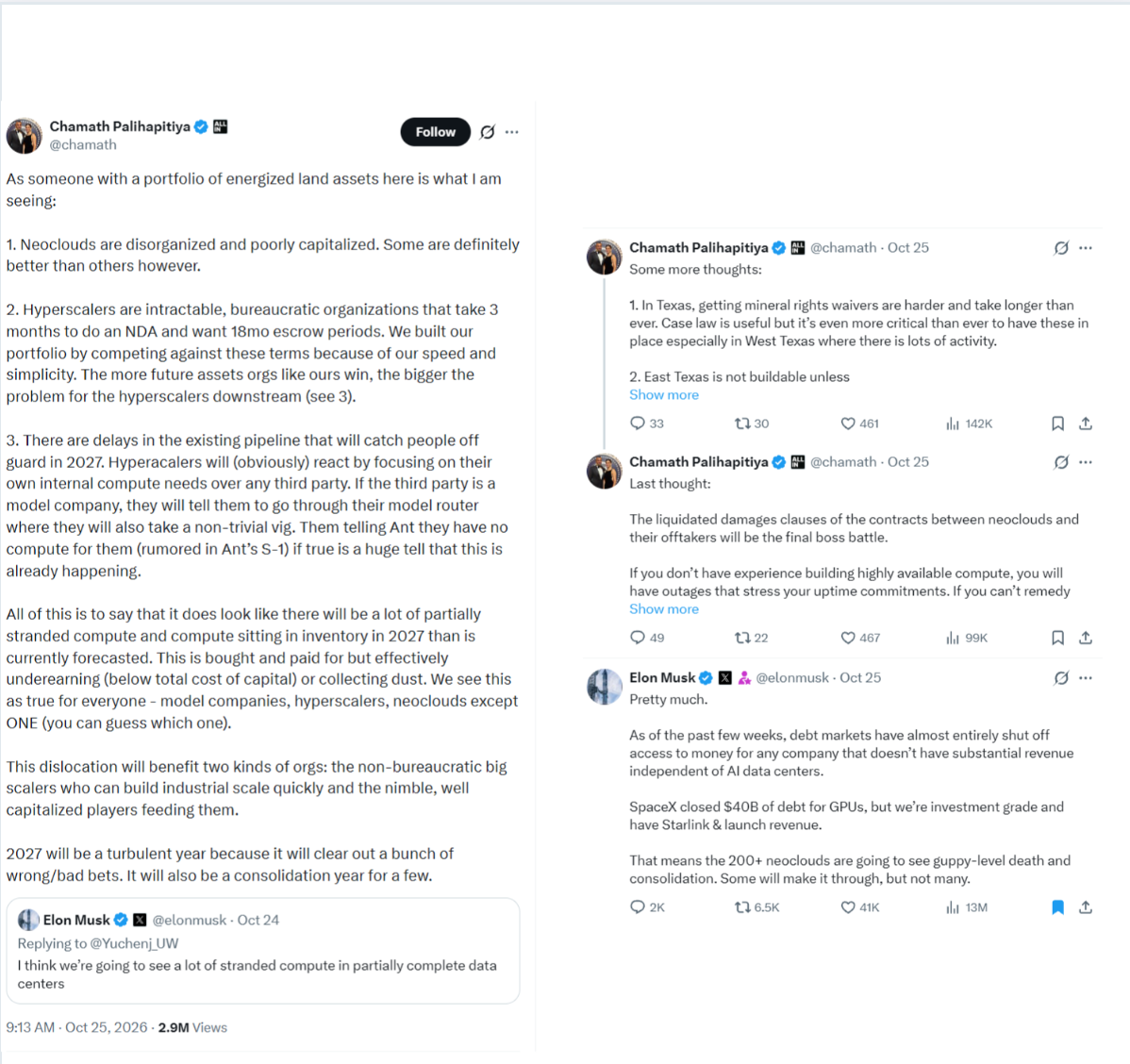
Nebius, CoreWeave and IREN fell on Monday morning and finished the day higher. Musk was not saying anything new. Gartner published a forecast on October 14 that more than 80% of neocloud providers will stop operating independently by 2030. Musk simply said it more colorfully, and with SpaceX's own $40 billion of GPU financing in hand.
I don't disagree with the direction. I expect a good number of the twenty companies I follow to be merged, sold or folded into a customer by 2030. But the discussion has been entirely about whether these companies can raise money. For several of the larger ones, that has been settled for now, and the money came from Abu Dhabi, Doha and Riyadh.
The less discussed question is whether they can build what they have already sold. A neocloud signs a contract for capacity that does not exist yet. Someone then has to bring a site online, install and commission the hardware, and keep it running. That takes electrical and mechanical contractors, site operators, network and reliability engineers. These people are scarce, and every neocloud, hyperscaler and colocation developer is competing for them.
So I looked at who twenty of these providers hired, and who left them, from January through September of this year. The Gulf-backed companies are not all doing the same thing.
Where the Gulf money sits
Five of the twenty have Gulf capital in a lead, anchor or ownership position, or were reported to be negotiating for it. Mubadala's money is confirmed in two of them, and Mubadala Capital was reported to be in talks to lead a round at a third.
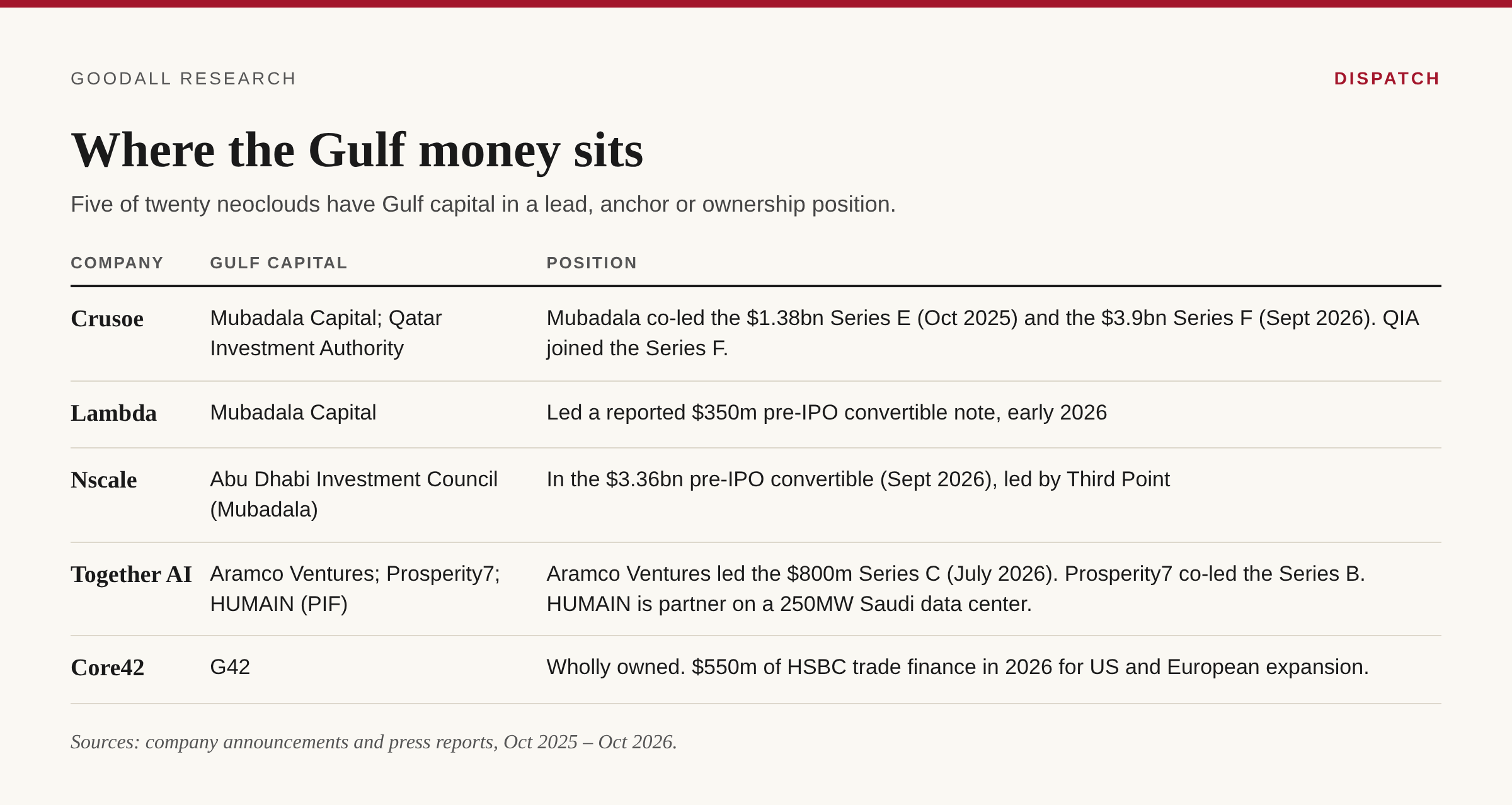
Mubadala Capital is the asset management arm of Mubadala. It has co-led two Crusoe rounds in twelve months, and in January it was reported to be in talks to lead Lambda's pre-IPO round. The Abu Dhabi Investment Council stake in Nscale puts a second Mubadala vehicle in the sector. QIA's only appearance among the twenty is as a participant in Crusoe's latest round.
The Saudi approach is different. Aramco's venture arms have backed Together AI through two rounds, and PIF's HUMAIN is supplying Together with power, chips and a building in the Kingdom. Riyadh is buying a position in the software layer and keeping the physical asset at home.
Abu Dhabi also owns the ground under some of this. MGX, which closed a $49 billion first fund in July, joined BlackRock's Global Infrastructure Partners and the AI Infrastructure Partnership in agreeing to buy Aligned Data Centers at an enterprise value of about $40 billion. G42 owns Core42 outright and is the UAE partner on Stargate UAE.
The rest of the field is mostly funded from the US. Fluidstack's equity came from Situational Awareness and Jane Street, and its largest build is for Anthropic with Google behind it. TensorWave's Series B was led by AMD and Magnetar. Vultr's last growth round came from LuminArx and AMD Ventures. CoreWeave, Nebius and IREN are public, with Nvidia and their hyperscaler customers as the most important names around them.
What a neocloud actually has to staff
"Neocloud" covers several businesses, and they need very different numbers of people.
Developers and fleet operators build or lease the sites, install the hardware and run it. Crusoe, Nscale, Fluidstack, CoreWeave, Nebius and Firmus sit here. They need engineers, but they also need operations staff, project managers, electrical and mechanical contractors, real estate and legal people. When these companies sign large contracts, I expect to see operations and program management hiring rise with them.
Platforms sell compute and software on top of hardware that someone else houses, and sometimes someone else owns. Together AI and RunPod are closer to this end. Vultr and Lambda are in between: they run their own fleets inside third-party data centers. These companies need software and reliability engineers more than site crews.
Sovereign and group subsidiaries draw on a parent. Core42 shares functions with G42. Yotta sits in an Indian real estate and infrastructure group. Their own payrolls understate the people working for them.
Gcore is a CDN and edge business that also sells GPU capacity, and IREN is a former bitcoin miner with a very different staffing model. I mention them for completeness and leave them out of most comparisons.
The point of sorting them this way is that a flat engineering team means different things in each group. At a platform it may be efficiency. At a developer with gigawatts under contract, it is a delivery risk unless contractors are carrying the work.
Who is staffing up
Hiring across the field peaked in early summer. June was the busiest month for engineering hires at CoreWeave, Nebius and Crusoe. After that it cooled nearly everywhere, and by September several companies were barely replacing the engineers who left.