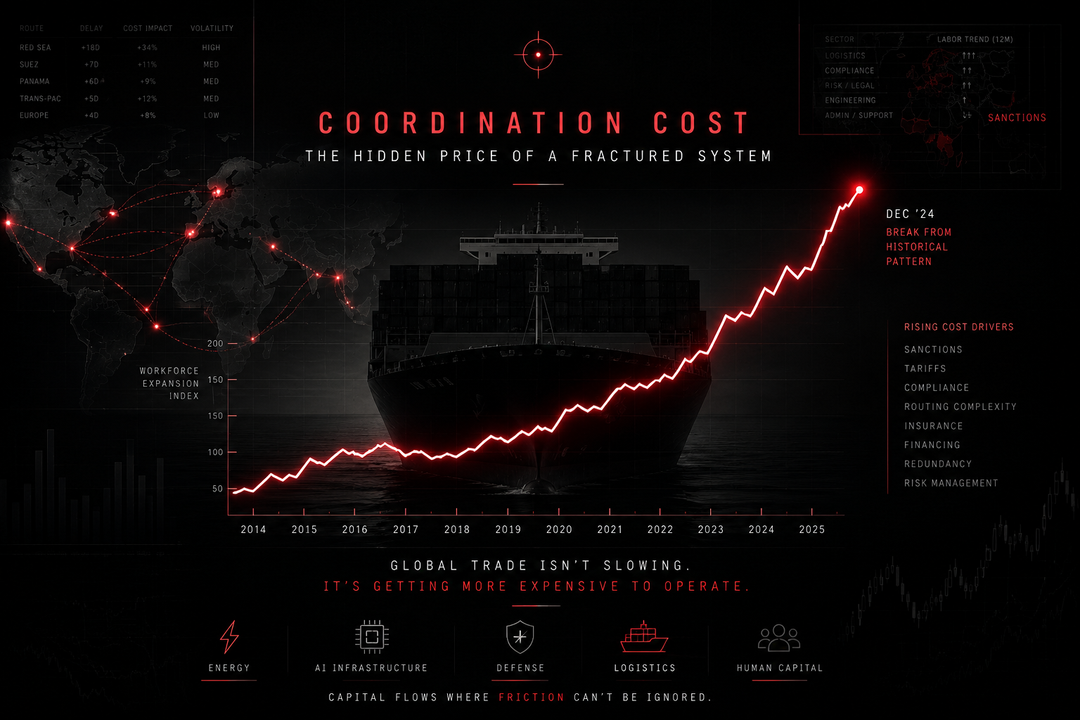
Global trade isn’t slowing… it’s getting more expensive to operate. Recent labor shifts inside logistics companies like Maersk suggest rising coordination costs, supply chain complexity, and structural changes that markets have not fully priced. I get asked all the time what I am watching… I’m keeping eyes on why sanctions, trade friction, and workforce signals are pointing to a non-cyclical shift in capital allocation.
In December, I wasn’t reading a policy brief. I was staring at a hiring chart from one of the world’s largest logistics companies that made no sense. Volumes were not booming. The company itself called it the “final stretch of peak season” with only modest growth expected. Yet they were deliberately adding labor at scale… in a pattern that broke from a decade of ruthless optimization. That is the kind of signal you learn not to ignore.
Shipping is supposed to be invisible. It is one of the most optimized layers of the global economy, designed to reduce friction, not absorb it… when it works, nobody talks about it. When it breaks, everyone feels it. But what caught my attention wasn’t a visible break.. but rather it was the opposite. It was a company preparing for something that hadn’t been admitted yet.
I built my own framework and model, and I track where capital is forced to move before markets fully price why, and workforce is where that movement shows up first. And let me tell you decisions don’t match hiring… Hiring doesn’t match demand… Cuts don’t match weakness, and expansion in areas seem quite defensive rather than opportunistic. That is where the data can tell you the truth.
The public version of what is happening right now is pretty familiar. Sanctions, trade tensions, strategic competition, supply-chain resilience. It is all presented as policy, as if the primary story is geopolitical intent.
This is why logistics labor is the canary. When Maersk adds headcount in a low-volume environment, every company downstream of global trade is already operating under a higher cost structure… whether their models reflect it yet or not.
That is why the Maersk signal matters.
Because when a company that has spent decades optimizing away labor suddenly needs more people to keep the system functioning, it is not a sign of growth. It is a sign that the system itself has become harder to operate. Routes are less predictable, and we are seeing compliance layers get heavier. Insurance and financing are also more complex. We have to face the fact that redundancy is no longer optional.
That requires people, and people are expensive. So when a company adds them anyway, it tells you something fundamental has shifted.
What caught my attention wasn’t just that Maersk was hiring, and it was when they were hiring…. and how far it broke the pattern from their own history.
This is a company that spent decades optimizing labor out of the system. Shipping scaled through efficiency, not headcount. Routes stabilized and processes automated. All in all, the entire model assumed coordination was cheap enough that you didn’t need more people to keep it running.
That’s what made December stand out. They also flagged inland pressure on rail and drivers, tariff-driven behavior shifts, and changes in inventory and warehousing strategy. Into 2026, they guided for only 2–4% global container growth amid ongoing geopolitical uncertainty and disruptions. Demand outlook remains cautious, supply chain issues continue, and key trade routes stay unstable. Hiring still moved in the opposite direction of the numbers. That mismatch matters.
Hiring moved in a way that didn’t match demand, didn’t match volume, and didn’t match how a company like that behaves unless something underneath the system has changed.
Based on historical patterns, you don’t see that kind of labor expansion outside of major structural resets…. aka, periods where the system itself becomes harder to operate, not just busier. From my pov, that is exactly the distinction most are missing here. If this were cyclical, you would see cost discipline, you would see tightening and you would see labor come out of the system.
Instead, what showed up was the opposite, which tells you something uncomfortable but important: The system isn’t being optimized anymore, it is being stabilized and stabilization requires people… and a lot of them. Once you accept that, the Maersk signal stops being about shipping and frankly, it starts being about everything that depends on it.
But that’s not what the data showed.