The airline industry has moved away from workforce expansion towards high selectivity at the exact moment the operating environment has become way less forgiving. It’s been a fascinating watch and peek into the world of what each management team considers indispensable.
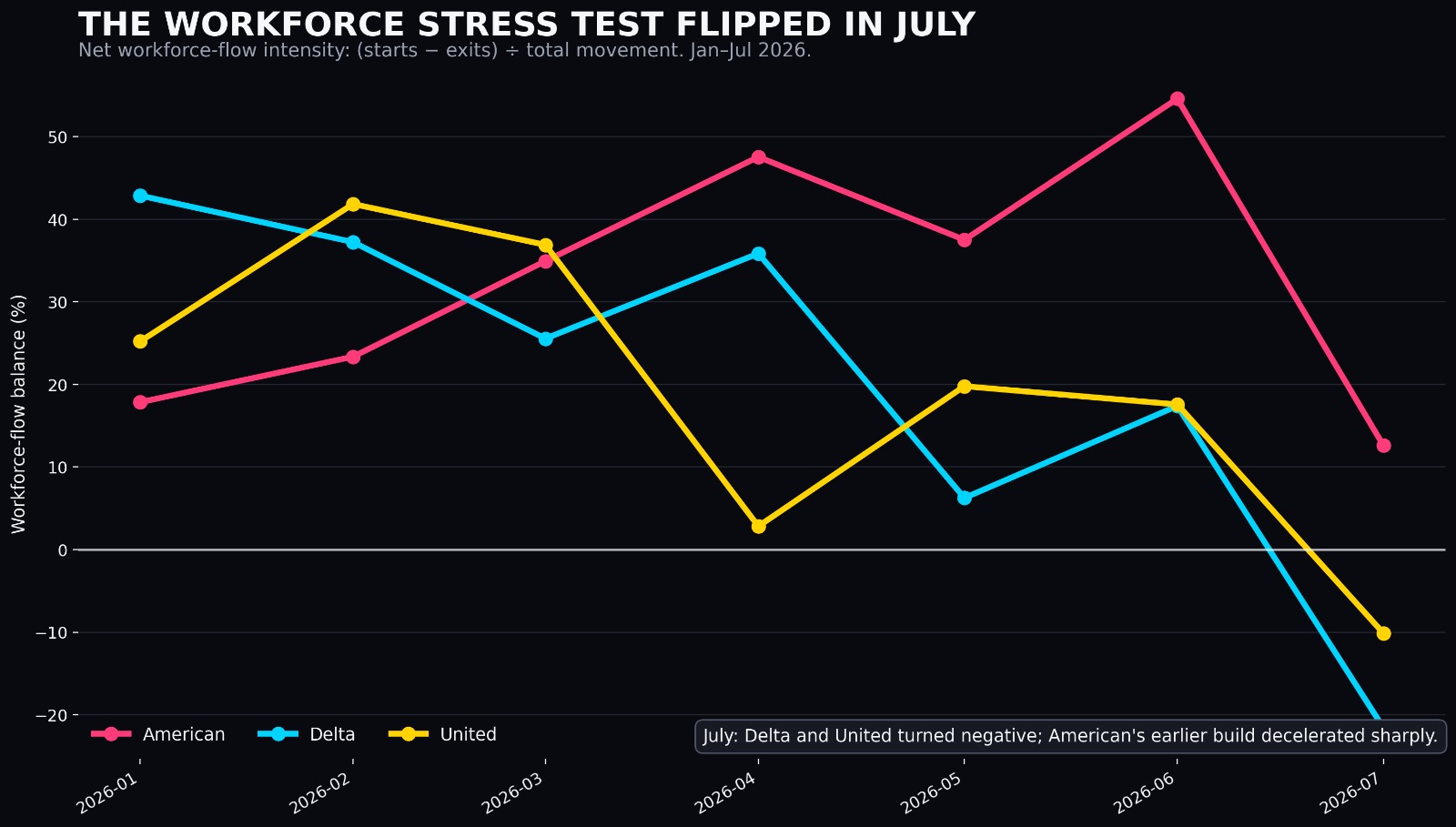
At the start of this year, 3 major airlines were adding people considerably faster than they were losing them. By July, that was no longer true.
Let me kick this piece off saying that jet fuel has become a much larger problem than crude alone would suggest. The U.S. Gulf Coast jet fuel/WTI crack has risen roughly 210% year-to-date. Jet fuel itself has just about doubled. More recently, the divergence has become particularly notable because what we have seen over the last 3 months is that WTI has fallen by about 12% and jet crack rose by near 50%.
In a cost shock, the winner isn’t who hurts least… but rather who makes everyone else hurt more.
So sure, crude has eased up a bit, but the product airlines actually burn has not and that is creating a fairly unusual operating issue. American, Delta and United cannot control the crack spread. What they can control, within limits is the organization makeup as a whole. Earlier this year, workforce formation across all three carriers was overall pretty positive. I saw more starts than exits. It looked like summer 2026 might have been one for the books. The last few months, that all began to change and workforce flows changed… they favored replacement and, in some cases, contraction. My initial thought was that the airlines are simply becoming cautious as fuel becomes more expensive, but that didn’t feel like the whole story.
I’ve said it once, and I’ll say it a thousand times… anyone can hire when times are good… and the real gossip is who survives when they’re not…. let alone, who might be facing layoffs.
By the time it makes headlines, the story has usually been unfolding for months.
I published my American Airlines research in August. Now we're seeing why those early workforce signals mattered.
I've made the full piece free to read.
If this is the kind of research you want more of, subscribe to Goodall Research and I'll deliver my latest findings directly to your inbox.
I spend a tremendous amount of time following these signals, connecting the dots, and testing what they might mean before the market catches on.
Your subscriptions and shares make that work possible. I appreciate every one of you.
The composition of the workforce is becoming super selective, and the selectivity is not the same across the three airlines. I will state this is normal, and kind of expected historically, but as these 3 major airlines are evolving, the recent changes tell me a lot about the near outcome for each.
United is cutting business and operational layers.
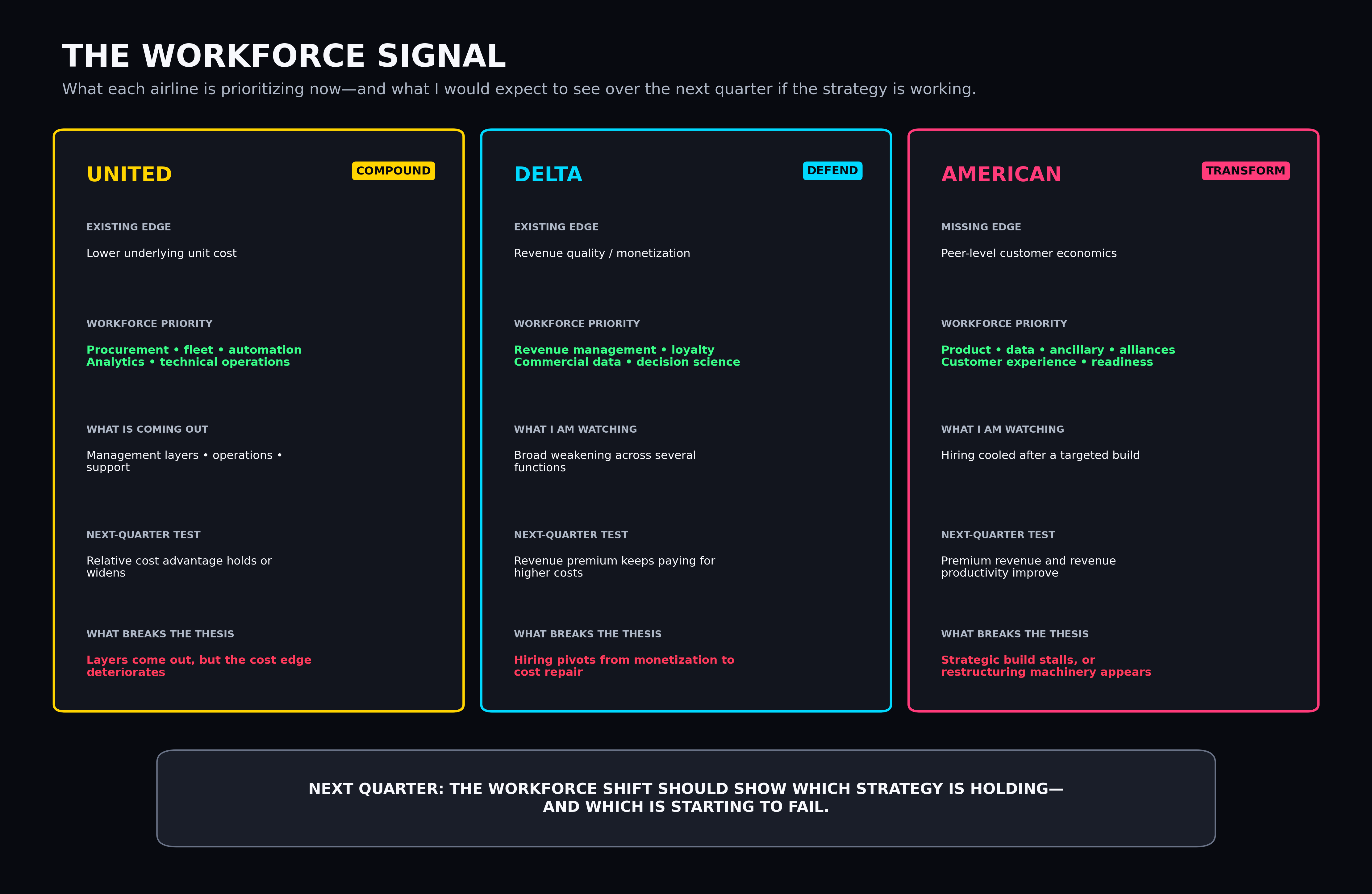
Management-heavy roles are coming out while procurement, fleet, automation, analytics and technical capability remain protected. That’s an important distinction. United isn’t just shrinking… it appears to be changing what kind of workforce it carries. Is this just a 2026 thing? I’m not so sure. If we’re reading this correctly, over the next quarter I would expect United to remain lean without losing operating performance. Its relative cost advantage should hold or improve. If it does, United is using the fuel price pressure to become harder to compete with.
Delta costs more to run and their answer is to make every customer worth more.
The Delta workforce remains concentrated around revenue management, loyalty, commercial data, decision science and operations research. Delta is straight up betting that it can keep earning enough to justify costing more. Over the next quarter, Delta needs revenue quality to keep doing that heavy lifting. If premium economics, yield and revenue productivity hold, the strategy should work. However… if the workforce suddenly rotates toward procurement, cost transformation and organizational efficiency, that’s a warning shot that is clear as day and it is telling us that management think that revenue may no longer carry the cost base.
American can’t blame fuel for the whole gap… so it’s trying to make each customer worth more.
The interesting thing here is that American and United are absorbing about the same in the fuel pressure game, but United is producing substantially better profitability. American’s workforce data is warning me that management thinks part of the missing economics can be found within product, data, alliances and customer experience. I don’t believe that this will fully show up in a single quarter, but the workforce should. Product, data, ancillary and customer roles should remain protected even as hiring becomes more selective. Then I would want to see early evidence of conversion… like better premium mix with revenue productivity. If those roles start disappearing, or American suddenly builds HR org design capability at the same time that management and support exits accelerate, well y’all… that story will change from transformation to restructuring real darn fast. I have some suspicions this is coming.
All in all, these are very different allocations of organizational capital and 3 very different bets. Success lies in the next workforce shift.
The one area to watch is that United and Delta both moved into negative workforce-flow territory while American remained marginally positive. And don’t get me wrong- I don’t mean layoffs at all… it comes back to the fact that management is getting selective.
Historically, once an organization stops expanding broadly, every remaining hire carries more information. At this stage, shocking as it might be, I am no longer interested in which airline is hiring, I want to know what each airline refuses to stop hiring for. So let’s really dive into each one and see what is happening overall. Remember- it’s about composition- not headcount, not who they are hiring for- but what they have and how it is working together. It drives a bunch of questions in my head like given the economics right now… what capability should management be building? Is that what they’re actually building? (if you are new to my work, you would be surprised to know, it usually isn’t) I also want to know what are they sacrificing to fund it? And what financial outcome should follow if they’re right? I mean price targets are a big deal… I also love to look at the leadership side of things. Are they crazy enough to pull it off, and will the board sign off. So much to unpack… I really went overboard this time to look into all 3 companies.
United: one helluva organizational substitution
United already has the cost edge. What matters at this point is if management is protecting the oomph behind it. The workforce is unusually clear: it is. What makes the signal stronger throughout all my data is that United isn’t protecting everyone. United has continued adding capability around strategic sourcing and procurement, fleet management, process optimization, analytics, automation and AI, technical business functions, maintenance, safety and digital compliance.
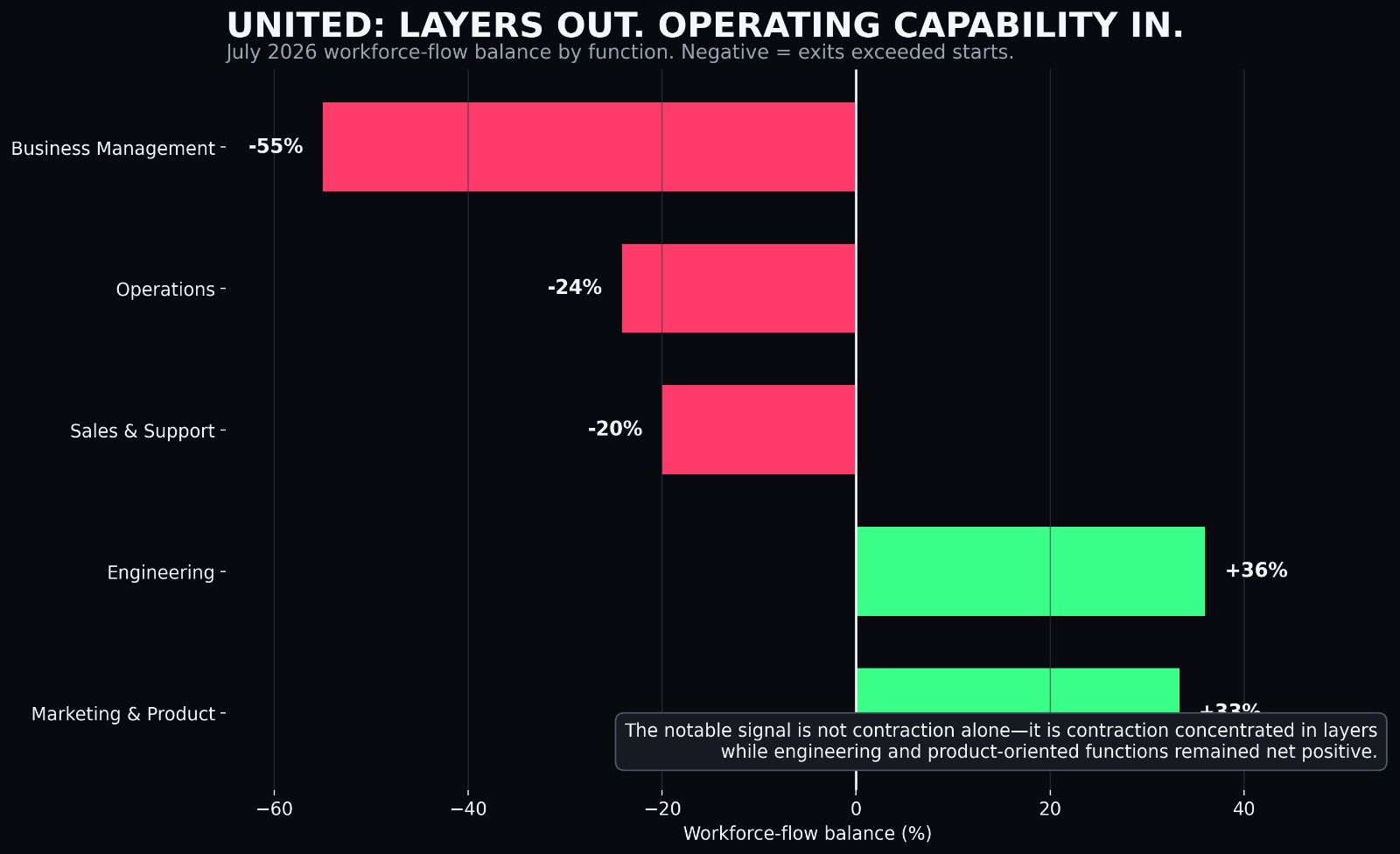
What makes United considerably more interesting is what is happening simultaneously elsewhere in the workforce. In July, Business Management exits ran at more than 3X starts. Operations also moved materially negative. Sales and Support contracted. In the airline industry, it isn’t common to see summertime workforce counts subsequently move lower. Overall, this setup looks more and more like a change in what kind of labor United is willing to own. Management has already discussed reducing mid level headcount and using process changes and AI to improve headquarters efficiency. The workforce data is consistent with that direction. The AI hiring I am seeing tells me very little because AI has become an almost mandatory line item in corporate hiring. And when we really get down to it, management contraction alone could be as simple as a focus on cost cutting. However, management contraction happening at the same time suggests something a bit more deliberate.
If that is truly so, the effect should become measurable.
United should be able to carry fewer org layers without degrading operational performance. Productivity should improve and the relative underlying cost advantage should remain intact or widen. This is the first forward test and honestly, the implications extend beyond savings. If United removes layers, adds automation and concentrates capability around the operating side, but relative cost position deteriorates, the workforce change up was wrong and it will hurt.
Something to consider is that United and American recently absorbed almost identical fuel burdens relative to revenue, yet United retained more than twice American’s operating margin.
A fuel shock does not necessarily affect competitive position equally, for the better operator, it may strengthen it.
That is what makes United interesting here because the organization is becoming leaner around the capabilities… United may use expensive fuel to widen the gap.
Delta: obvious weakness is being ignored.
Delta presents almost the inverse case of United..
Its underlying non-fuel operating costs are materially higher than United’s and are rising faster. And if I looked only at that fact, I would expect the workforce to be rotating aggressively toward procurement, automation, and roles that handle the structural cost transformation - but it is not what I am seeing.
Delta has been allocating talent around revenue management, commercial strategy and data, loyalty, decision science, operations research, international customer experience, aircraft performance, fleet and technical operations, and enterprise strategy. They have also historically justified a more expensive operating system by producing better economics from it. Current margins remain strong, passenger yield and revenue productivity remain stronger as well and loyalty/premium positioning create economics that do not exist solely in the base fare.
United is defending what it costs to produce a seat mile while Delta is defending what it can earn from one.
The workforce data gives me unique a forward indicator. With July’s workforce flow weakened broadly we see that management, engineering, operations, HR, IT and program/project functions all showed deterioration. Now of course, one month is not a complete restructuring signal… it is enough to establish a watch condition. The first part of August is already giving me something useful… but not a complete picture yet. This isn’t looking like last summer. In 2025, Delta’s July workforce and weakness worsened dramatically. The exits were spread heavily across management, engineering, operations, product, IT and support, and the workforce just kept shrinking into the fall. So far, August 2026 isn’t following that pattern. Some areas are fairly tight, I’m not gonna lie, but management, operations and support are looking healthy.
From my POV, Delta is just getting much pickier about where it puts people… and that is why with the fuel situation this can get ugly fast.
Now if they do cut revenue, commercial, loyalty, and the other major functions behind Delta’s concept to get more out of customers that’s when I will pay attention. The workforce will have changed the story before the financials do.
The signal I would care about more is a change in strategic hiring itself. Like if Delta moves away from monetization hires into procurement or some kind of cost control- I will want to know why because frankly, those hires, while not bad, would represent a change in the management’s assessment of the problem.
I don’t care whether the total headcount is +50 or -50. I care whether the functions that Delta has chosen to rebuild after the 2025 contraction remain protected through the 2026 fuel shock. This is a big one here. If they do, management is still betting on the existing model. If they don’t, that is straight up saying the workforce shift and Delta’s strategy may be changing.
That is what I am watching next quarter.
American: do somethin’
American Airlines right now is the most useful case for understanding why workforce growth should not automatically be interpreted as strength.
Its underlying non-fuel cost structure is higher than United’s but substantially below Delta’s,… yet profitability remains dramatically weaker.
The fuel shock is exposing American’s economic weakness- but not fully responsible.
The workforce data tells me that management understands that difference, and their recent formation has included senior product leadership, product design, technical product management, data engineering, ancillary development, alliances analytics, category management, customer experience, and global training delivery talent.
The interesting thing here is that American isn’t staffing like a company trying to become the lowest-cost operator, but rather change the economics of its customer.
This all aligns with what we can see American doing with physical capital. Management is increasing premium capacity and adding higher-value seating. Premium passengers already contribute a disproportionate amount of ticket revenue. Product leadership determines what American sells. The workforce sits under this.
Product design determines whether the experience can justify a premium, and then of course, we see data engineering supporting pricing, personalization and measurement.
American appears to be building the organizational infrastructure required to increase the economic value of the passenger.
That is the American thesis, and it is also the reason I assign it a higher burden of proof moving forward.
Hiring can identify the advantage AND the deficiency for a company.
Frankly… this is the point where aggregate workforce analysis can become very misleading. Let’s suppose two companies each add 20 people to a strategically important function. Sure, the hiring signal looks identical… but in reality, it may mean almost opposite things, and usually does.
One company may be adding to a capability responsible for superior financial performance, while the other may be adding just because management has finally identified the capability it lacks. It can even happen at the same time in a sequence of hiring, but how it is used is vastly different.
The first is reinforcement. The second is repair.
United’s and Delta’s current workforce formation is largely reinforcement. American’s is much closer to repair.
This makes the financial test different because with reinforcement, the existing advantage should widen and with repair, that existing disadvantage has already starte to close. American needs conversion at this stage.
If product, data, ancillary and customer capability continues to receive organizational capital, better passenger economics should follow… like premium revenue, revenue productivity and ultimately the margin gap should begin narrowing.
If it doesn’t work, this straight up is evidence that management is spending organizational capital without receiving the required return.
So I will shout till I am blue int he face that hiring is not inherently bullish. Sometimes the jobs tell you exactly where the company knows it is weak.
American is also running on a different time schedule.
The transformation of an airline takes years. Aircraft have to be modified, premium capacity (in this case) has to start, customers also have to notice the difference. Pricing has to hold and it all has to start getting better. To get to that point, the workforce started at the beginning of this multi- year transformation which ultimately creates a period where management can recognize and handle the problems and when investors take notice to see if the solution worked. The divergence and narrative gap is HUGE.
American Airlines is currently in this mix, and that makes their next workforce move more important than just a headcount total hiring.
The reality here is that if those strategic functions start disappearing before the economics improve, the signal deteriorates, and it can be quite quick. For instance, if American starts adding employee relations, compensation, organizational-design or restructuring capability while management and support exits accelerate, something else has happened. The company would be attempting revenue transformation and structural cost repair simultaneously. D.A.N.G.E.R.O.U.S.
Given their smaller margin cushion, that would materially raise the execution risk. I do not see enough evidence to make that call today.
Then we also have the layoff signals. A hiring slowdown is not sufficient evidence of layoffs, nor is declining headcount useful without knowing exactly why.
In this particular comparison of the 3 majors, United currently gives us the clearest example. Delta may be beginning a period of broader selectivity, but has not yet materially changed the capabilities it appears to value most. American has slowed after a significant capability build, but the product/customer architecture remains the more important signal.
That is why the composition matters more than the count.
- A company can reduce 1,000 people and weaken itself.
- Another can reduce 1,000 people and improve itself.
The number does not tell us which happened… the functions do.
Investors are accustomed to studying financial capital allocation under stress, and in all of my work and reports to clients, workforce allocation deserves similar scrutiny.
Fuel shock vs the airlines.
United is protecting operating control.
Delta is protecting monetization.
American is building customer economics.
Now those choices have to produce results.
I expect to see a breakout next quarter…
At United, I want to see if the management contraction continues while procurement, fleet, automation, analytics and technical capability remain protected.
If United becomes organizationally leaner without losing operational performance… WOW.
At Delta, I am watching if the broad workforce weakening seen in July develops into a pattern. If the company continues protecting revenue management, loyalty, commercial analytics and decision science, management is still defending monetization and pushing ahead.
At American, the question is whether the capability build remains protected long enough to convert. Eventually those investments need to appear in premium revenue and better revenue productivity.
So who can absorb the fuel shock?
Delta has the strongest shock absorber today.
United may have the more interesting forward setup.
American is attempting something harder.
That difference in the end matters more as the environment becomes less forgiving, so I am not particularly interested in declaring a permanent winner among the three… yet
I am interested in knowing when the evidence changes… in the end, the financial statements will eventually tell us which strategy worked.. but the workforce should move first.
The next workforce shift will tell us which strategy is beginning to fail. I’ll report back in another month on where they are at. I’m not finished watching this.
Amanda